Fuses are fundamental safety components in electrical systems; they protect circuits and equipment from damage by automatically cutting off the power when an overload or short circuit occurs, causing the internal fuse element to heat up and melt.
Different damage patterns indicate distinct causes of failure. By examining the shape of the break in the fuse element, one can determine the root cause of the circuit fault. Mastering these patterns can significantly reduce the time required for troubleshooting.
I. Correlation Between Breakage Patterns and Fault Types
Scenario 1
Appearance: The fuse element breaks only at its narrowest point; the fracture surface is relatively smooth; the inner wall of the fuse shows only faint yellowish smoke stains; there is no significant metal spatter.
Fault: The circuit has been operating under long-term overload. Continuous heat accumulation eventually caused the element to melt. This is a “natural” melt-off caused by gradual heating, without the impact of a sudden, massive surge of current.
Scenario 2
Appearance: The fuse element is almost completely vaporized or consumed; the inner walls (whether ceramic or plastic) are coated with dark gray/black metal dust particles; in severe cases, the casing may crack, and the end caps may show signs of scorching.
Fault: A severe short-circuit fault occurred (e.g., phase-to-neutral or phase-to-ground). A short-circuit current—several to dozens of times the rated current—was generated instantly, causing the element to vaporize rapidly within milliseconds. This is a critical electrical fault; the specific short-circuit location must be identified and rectified before installing a new fuse.
Scenario 3
Appearance: The break does not occur in the middle of the fuse element but is concentrated at the weld or contact point between the element and the end cap; the rest of the element remains intact; there are virtually no scorch marks on the inner walls of the fuse.
Fault: Overheating caused by poor contact. Common causes include insufficient contact pressure during installation, loose terminals, or oxidation/corrosion of contact surfaces over time. This results in excessive contact resistance; as current flows, heat builds up continuously at the contact point, eventually burning through the element at the connection. The issue lies with the connection itself, not with the circuit’s load or a short circuit elsewhere.
Scenario 4
Appearance: The melt breaks at inconsistent locations, showing multiple irregular fractures; some fracture points exhibit clear signs of secondary melting and adhesion, and the pipe wall shows slight, uneven smoke staining.
Fault: The circuit experiences intermittent short circuits or repetitive surge loads—such as frequent forward/reverse motor operation, occasional casing contact due to damaged insulation, or frequent starting/stopping of high-power equipment. Repeated short-duration overcurrent surges cause cyclic heating of the melt, ultimately leading to irregular fracturing.
II. Troubleshooting Methods
- Full-melt spatter (short-circuit characteristic): Disconnect all loads first; use a multimeter to measure resistance between phases and between phases and ground. Confirm the absence of short circuits before attempting to restore power.
- Mid-section melting (overload characteristic): Calculate the total power of connected loads to determine if the circuit’s rated capacity is exceeded; remove excess load before replacing the melt with one of the same specification.
- Melting at contact points: Check the fuse base contacts for oxidation or deformation and inspect terminal screws for looseness; clean/polish contact surfaces and tighten terminals before installing a new fuse.
- Irregular fracturing: Investigate whether high-power equipment is frequently starting/stopping or if there are hidden faults like insulation aging; if necessary, replace the melt with one rated for the next higher current level.
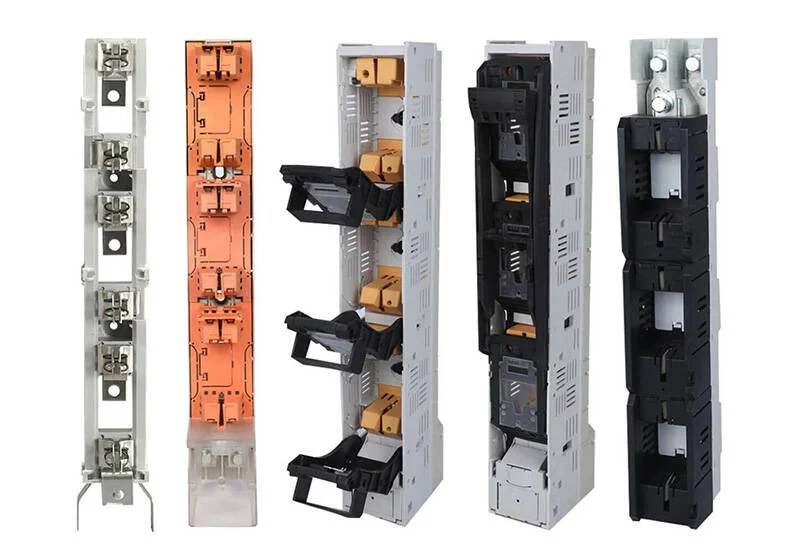
BARFUSE Electrical Co., Ltd. is a specialized manufacturer of low-voltage fuse-switch disconnectors, busbar systems, and high/low-voltage power distribution and wiring management products. Its products are widely used in low-voltage power distribution systems across industries such as petroleum, chemicals, metallurgy, electric power, and construction.